Thursday, August 19, 2021

Child of a Lonely Star (2)


Previous: A disintegrating ship arrives from the quarantined Aldebaran system. Moast and crew recognize it as a message from the sentient world Aldebaran C. 

The assembled space station clung beneath Orchidia's broad launch bay. Commander Moast climbed down and sealed the hatch behind him. "Ready for launch, Kyra," he said to the science officer on the distant bridge. Entirely automated, the station fired thrusters to insert itself into high orbit. This far from the planet, the entity would give up considerable power.

"Hoy, Commander! Jolly good digs, wot?"

The android guide for the world spirit appeared at Moast's side. The AI had taken Moast's instructions literally: since the android was custodian of a vast TV library, she had fashioned him after  British actor Bernard Fox, who played the butler Malcolm on the Andy Griffith show. 

"Of course," Malcolm added, "you may not recognize me the next time around. This goddess of yours may turn me into a tea cozy! Ha ha! Ho ha!"

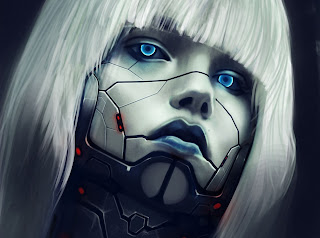
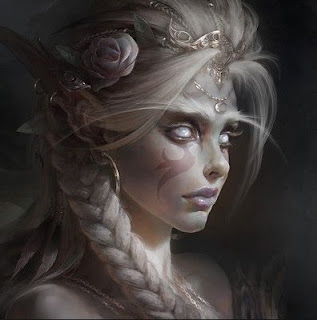
"Right." Moast was about to page the library listing when he faced off with a frightening harridan. As his pulse settled, he said, "Orchidia, I liked the punkette you were modeling before. This one I wouldn't turn my back on." 


"A forbidding appearance is necessary to convey ours as the position of strength."

Malcolm chuckled. "Avatars, ey? Gotta love 'em!"

The two artificials eyed each other. 

"Right." Most scanned the mile-long list of reject titles, not having seen any of the vintage stuff. "Hmm. Dances With Wolves, Avatar, All In The Family."

"Anti Caucasian stereotypes," said the AI

"Everybody Loves Raymond, Home Improvement."

"Denigration of the father figure."

"She's very thorough," Malcolm said solemnly. 

Moast hit the panel com link. "Kyra, status of defense measures."

Her voice was tinny through all the shielding. "Shields are on millisecond rotating frequency. The planet-buster bomb is on standby. Hyper jump actuators are powered up." A pause. "I don't like the idea of leaving you behind."

"We'll play it by ear," Moast said. To the AI: send the RSVP." Beneath the station, colored lights rolled and flashed a complex message for an entity with no understanding of a spoken tongue.

"Here now," Malcolm said. "How shall we address the lady? Your Majesty? Your Grace?"

Moast crossed arms in the pose he'd greet her in, showing confidence he didn't feel. "This is Aldebaran C. We'll call her Cee." Seconds later, a figure materialized, leaving him speechless.


"It can't be. . . .this is exactly how I pictured a goddess."

The AI signaled a colorful greeting, one echoed by Malcolm. "This implies an ability to sense your thoughts. It will enhance communication."

"Most pleasing," the commander said with a cavalier nod of the head. The goddess deigned to return the gesture, though he wasn't sure she understood it.

"Curious," said Orchidia. "Despite immense power, her posture is one of supplication. You are key to future visits, a subject of all-consuming importance."

Unexpectedly, Cee conjured a small object and sent it floating toward Moast. Since the AI raised no alarm, he allowed it to settle on his hand. 

"Marvelous!" Malcolm crowed. "A tiny miniature of your ship, in ruby, no less!" 

"Impressive. She has transposed the gem from beneath the surface. The object is of permanent construct." The AI waited. "She expects something in return."

Moast knew what that was. The notion of taking her hand filled him with a vision of being absorbed like a data file. He forgot that she could sense his thoughts. From her lips came a bass tone of such intensity that he rushed hands to ears. Correcting her mistake, Cee switched to a softer tone of higher range, let it trail off like the  notes of a heroic opera.

"That I like," Moast said with a reassuring smile she probably did not understand. 

"The sonic gift is further assurance of fair play. Proceed with caution." Orchidia flashed a colored message, no doubt reminding the entity of the consequence of treachery. But again, was such a  human trait even comprehended by the soul of this world?

Moast drew near, noting a few colorful sparkles in the white gown.

"Apprehension. She does not want to harm such a delicate being."

"Outstanding." Moast forced his hand out, which Cee reached for. Hers was cold and wooden, but rapidly adjusted, becoming warm and pliant. There was even a bone structure. Suddenly he was assailed by a vivid memory: two woodpeckers in a sunlit tree, clinging to a windblown branch against a sky of startling blue. He had watched the scene for some minutes in awe of it.

Orchidia flashed warning colors, and Malcolm rushed to prop him up. 

"I'm okay," Moast said. "That was quite a memory tap." He returned to the com panel. "Kyra, stand down the weapon. Send a shuttle for me." He watched the goddess, who radiated colors of obvious relief. "Well, Malcolm," he said with a back slap. "So begins your job as genial host. Work on the hand clasp. In time, you might even venture a hug."

Malcolm glanced at the shimmering goddess. "Er. . . .yes sir. That is, sir, uh. . . .yes sir."
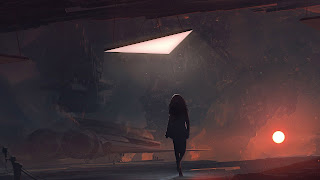


Tuesday, August 17, 2021

Child of a Lonely Star


They dubbed the mystery ship "Evil Twin"; not that it showed evil intent, but for being a half-scale copy of Orchidia. It didn't even survive its journey from the Aldebaran system. Other ships within Pluto Station backed away, weapons aimed, as the visitor began to wilt and come apart.

Portly Admiral Jacobs gaped out the panoramic window of Central Ops. "A plant? That thing is a plant?"

A junior officer hunched over his terminal, rapidly pulling up scans. "Mostly, sir, with enough metals for a drive unit. No one thought biologicals could bond with metal at the molecular level. It's almost like. . . ."

"Go on, Lieutenant."

"Like it was wished into existence."

Jacobs paced, watching enviro units clean up the mess. "Call up the file on Commander Moast's mission to Aldebaran."

Seconds later, the young man had the highlights. "Two crewmen died on the surface. When their duplicates tried to fly their shuttle back to Orchidia, Moast shot it down. He was about to launch a planet buster when the surface displayed colors the AI interpreted as contrition. He listed the system as of no interest, and recommended quarantine."

"Ah yes. The sentient world." Jacobs watched Orchidia already sailing toward the cleared portal hatch, one of thousands in the moon-sized sphere. The Builder artifact still wasn't completely explored.

"Wait one," the lieutenant said to an incoming message. "Admiral, Commander Moast requests clearance for departure to the Aldebaran star group."

"By all means," Jacobs said. "I can't wait to hear his explanation for this."


Orchidia exited the Aldebaran portal at a risky clip, artfully weaving through the asteroid belt. The Builders had a penchant for hiding the portals until the natives achieved space travel. Several hyperjumps shortened the trip toward the orange giant star and its only known planet until now.

At eleven times the mass of Jupiter, Aldebaran B orbited too close to the star to support life. Not so for Aldebaran C, sheltering in the umbra of B. Refracted light gave C a permanent state of twilight.

"Nuke me sideways," mused bearded navigator Chet.

The muscular helmsman Berl agreed. "No way that happened all by itself. "

Moast swiveled toward Science Officer Preston. "Seems like we're expected, Kyra. What do you make of those colors?"


"Joy," she began. "Hope, curiosity. And a proposal." She studied the spectral scanner. "More complex now. We'd better bring in the AI." 

Moast had speculated how the planet wanted to use his ship for seeking out and bringing other life here. Had that changed? The threat of a planet-smashing weapon still hung over the entity's head. "Orchidia, analysis." 

"No ethical center is apparent beyond cause and effect reasoning. Spoken language is an alien concept. Until our first visit, there was no awareness of other life. This has engendered loneliness. Stand by." After a pause: "Based on contact with the deceased crewmen, there is curiosity about touch."

"Commander," Kyra said, "you aren't planning on going down there. . . ."

"Not a chance. I propose a neutral ground. Orchidia, modify the orbital station as a culture center. Make sure the TV shows are free of propaganda, virtue signaling, and hypocrisy. Ready an android to serve as guide and companion. Instruct the entity to assume a form suitable for boarding."

Kyra's lips pursed in dismay. "You're going to meet her face to face? It's insane."

"I'm reminded of a line from a poem: Intrepidly into the void, I trow." 

"Trow?" Kyra looked up at the holo emitters. "Orchidia--"

"I trow: I speak truly. It is easier to pronounce than 'troth', which in turn requires fewer mouth muscles than 'truth'. These are examples of lazy speech that gives rise to dialects."

Moast entered the turbolift. "If the vocabulary lesson is over, we have a culture center to inspect."

"There's an end game to this. We aren't out here to entertain a sentient planet."

"We have a chance to learn how planets form. because this one can tell us. And a ship in distress can get parts conjured up quick. Temporary, maybe, but enough to see them home."

"If this entity can be trusted," Kyra reminded. She followed the commander into the corridor leading to the hangar deck. "Moast."

He stopped and looked back.

"We can get all these things without so much risk."

"You're convinced I'm going to take one?"

"Taking risks is how you came up the ranks. But this. . . .why?"

Moast shrugged. "Never held hands with a goddess before."


Monday, August 16, 2021

Morning Freewriting

Freewriting is all your own.  Express your thoughts as much as you want.  Call it a mental purging to reorganize the mind to get it in gear.  Worry not for grammar or detail, this is your journal time.  No one is going to be looking over your shoulder or grading your form of expression.    


art journaling GIF by SoulPancake


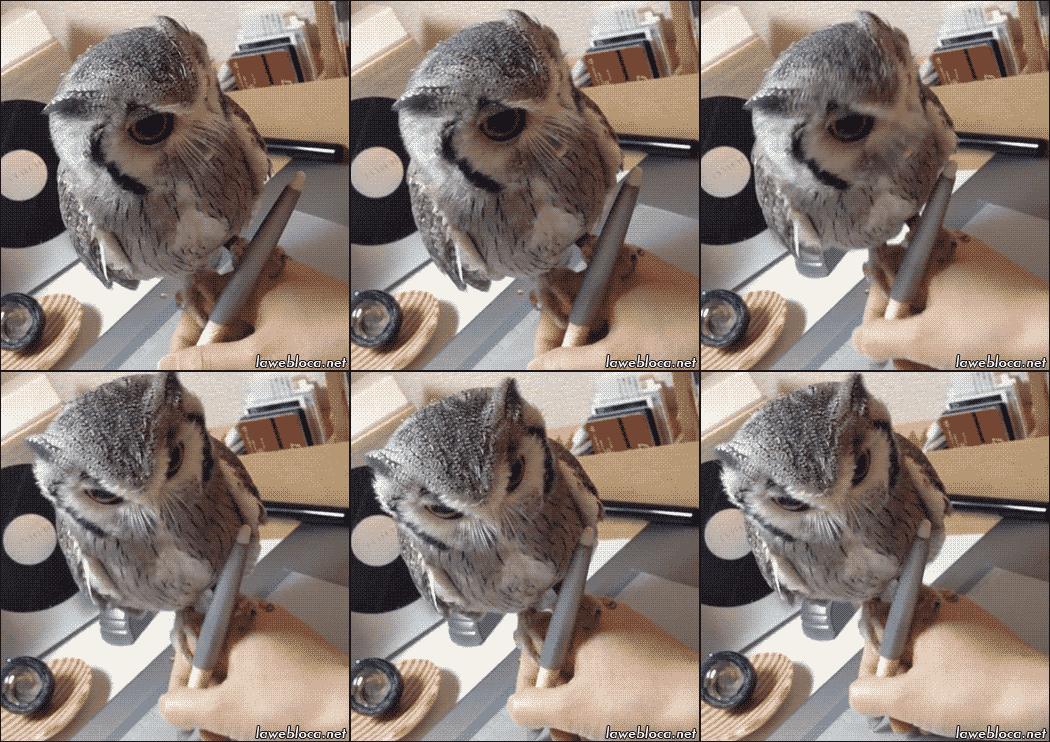
Hand Owl GIF


Many people, whether they are a writer or artist or not, it helps in so many ways even in the profession you are in.   Try writing out a page or two, then throw them away. It's a way of letting go of issues that keep hanging on. When the new dawn comes, you can start again afresh and make your project shine as it is meant to be.    Once I get through the morning freewriting my storytelling or art is a much better flow.  Just let it go. Are you ready?  What's stopping you?     


Friday, August 13, 2021

Friday Writing Inspirations


Kids are at school and I am very thankful to have this moment granted to work on the book.  I get up and contemplate the scenes that need to be written with more attention.   Are you one of those writers?  Get the story out, then edit or revise?   My new routine is breakfast outside with the coffee mug with a snowman on it.  Do we really have 20 weeks left till Christmas?  Something to think about, or not.  I think I tend to order things online now that I am older and don't like crowds much.    


Topic today is on transitions in writing.    Once you churn out the details of the main idea of your manuscript,  transitions shift the mind gently to the next scene in sentences of the paragraph. Like a work of art that has elements to design, writing also has its own elements to make the piece flow.   Here is a video for thought on the focus of the craft in writing.


Lastly, enjoy working on your piece.  It is your niche, and don't forget the music if you need something to keep your creativity flowing today.  I am thinkin of something between heavy and moderate rock.  


Have a great Friday and good luck on your project!


Thursday, August 12, 2021

Incident at the Dragon's Tongue


Khot, City of Thieves, in the Canal District

The Dragon's Tongue tavern sprawled drunkenly at the apex of an ancient conical tower. Chain bridges radiated from the landward side, linked with broad wooden plazas abuzz with commerce. Voices and gull calls augmented the rhythmic bang of a pile driver down in the boat yards.

A trio of thieves, the male burdened with a large sack, stepped onto the central plaza to take stock. Outwardly the tower looked serene against cold marbled skies on this winter morn. A milling crowd signaled trouble; they kept parting to allow casualties passage down the stairs.

The aproned tavern owner stumbled toward them. "Jili, you gotta do somethin'! Get in there and stop that big farm woman tearin' up the place!" He eyed the sack with mercenary interest. "I got a right to know what she wants with you." A sudden gust had him clutching the chain, whereas the sure-footed thieves never wavered. 

"Last moment change of plans," Jili said. "I was supposed to deliver this at Lunari, but Eolcan agents found out. I set up a meeting at the Lair, but they said they'd find me instead."

"And so they did! What. . . .are you supposed to hand over?"

Skuff wore his usual droopy-eyed sneer beneath his top knot. "It ain't safe to know that. Even we don't know. Ya'd think Jili had her dirty laundry in there."

"We'll handle it." Karla gave him a back slap, causing him to flinch before the mistress of blades. Onlookers made way for them, anticipating a new element of calamity. 

The trio climbed steep wood steps, where a few rowdies opened the doors with a mocking flourish. A dingy passage led down to a garish red velvet vestibule. Its curtain was pulled aside on a scene of comical destruction; comical because of the overhead balconies, whose denizens enjoyed the show, once they realized the brawler had no interest in them. 

"Way, way out," Karla mused as she navigated busted chairs and overturned tables. Patrons overhead shouted down taunts about their chances against the fighting whirlwind behind the bar.

Said whirlwind, wearing a simple dress and head wrap, watched them with arms folded. Most of the bottles behind her were shattered, infusing the air with the smell of ale and beer. 

Jili righted a table and chairs, and Skuff dropped the sack there. He slapped the boards. "What's somebody gotta do for a little service?" He took the middle seat, watched the amazon swing legs over the counter, whereupon she took a seat opposite them.

"Only a Red Claw," Jili said, "would pull a stunt like this, and there's only one who'd be interested. It's been awhile, Caladra." 

The Red Claw leader pulled off the wrap, showing the tinted white hair of her tree-dwelling culture. 


She looked inside the sack with pained reverence. "I never thought to see Eiridne's armor again, since that day you poisoned her, and she passed command to me."

Skuff began thunking his dagger ever closer to her hand.

"I was only a child," Jili countered. "What would you have done when commandos swooped in to kidnap you?"

"Our mission was to kill you," Caladra reminded, "because you're prophesied to destroy the empire. Now I'm an unwitting part of the conspiracy that brought you here. You're supposed to be serving the empire, not the king of thieves."

Skuff's blade thunked perilously close to her hand. With a swift backhand, she snapped off the blade. "Hey, nobody breaks my pig sticker without payin' a price--" He didn't reckon on the amazon's long legs, which upended his chair and spilled him out. He rolled backwards to riotous laughter. Then he returned to his place as if nothing had happened.

"Skuff. . . ." Jili closed eyes in exasperation.

"What about that thing about having the armor?" Karla asked. It was normally a death sentence once the amazons caught up to you.

"I trust," Caladra said, "it was not at any time displayed for ghoulish amusement." The wrong thing said here would start another round of destruction.

"No one has seen it." Jili waited.

Caladra rose and shouldered the sack. A few observers fled back upstairs. "This will be delivered in state at our base in Daumastia. Thence it will occupy the most honored place in the Hall of Heroes."

The group made their way outside to the spidery network of bridges and broad plazas. Crowds took shelter under awnings when a wyvern wheeled in from over the river. Its pilot set down precariously on the sea wall. 

Caladra's parting look spoke of a never-ending concern.

"I know," Jili said. "Eiridne's daughter must never find out about me. I don't relish a fight with a tier six sorceress."

After the wyvern took wing with its passenger, one of the cafe owners trotted gingerly across a bridge, a covered tray in his arms. "Jili, this for you! Thanks for getting rid of that lunatic amazon. All my customers were out here watching the fun, and I'm going broke!"

Skuff parted a fold with the stump of his dagger. "What this sheep dump?"

"Eastern cuisine!" the chef protested. "Cabbage rolls with brown mustard and cinnamon. Yak ribs with honey and cherry sauce."

"Sold." Karla took the bundle. Having fled a privileged life, she was familiar with the finer things. "Let's find a hidey hole and dig in. Since we got nothing for the armor, the day isn't a total loss."


Saturday, August 7, 2021

Systems set for Creativity


Happy Saturday!  It's been a week of prepping the kids for school and car repairs. Just at the rim with priorities to my ears.   They have a way to wedge themselves between our creativity to make us productive.    Many artists and writers have their own set up that encourages the clarity with motivation to be productive. For now my place is in the kitchen looking at the fridge and a window next to it over the counter sink.   I do have a system that works.  What is yours? 

Get adequate sleep.  A rested mind and body ensures the best and generates fresh new ideas and tackling angles that have not been thought before.


    What is your system?  Does it help or you make it work regardless the settings.  My quiet area was the artist/writing room before the kids.  I gave up the back bedroom so they could have the bedroom.  To be creative and having a vision of your manuscript or art piece keeps going on in your mind, take down notes or draw up sketches.   

    Exercise is a must.  As creative people, we also love variety not only in our projects but in our lives.  Maybe take a walk and get some fresh air, do something different to change up the routine by keeping active.

Woman With Dumbbell While Exercising On Fitness Ball. Young Woman Holding Dumbbell While Exercising On Fitness Ball In Living Room stock photo


Vestibular input.  Lay on your back on a yoga ball, and roll back with your head back.  This gets blood flow  to the brain and really helps with cognitive function.  

When my work gets stagnant I take a break and do something different. Life is busy but I make time.


Eat a well balanced diet.  Reduce sugars and carbs.  Eat complex carbs and increase leafy greens such as spinach or kale..  Fish is one of my favorites when I am looking at a working night to be productive.


Baby Spinach. On wooden table stock image


Fresh salmon. Steak on the table royalty free stock photography


And lastly after a delicious meal, treat yourself with a dessert.  Make it a coffee with a cannoli or something of your choice.   With these easy steps you will be ready to get the mind flowing way into the night if you are a night owl like I am. Tucked away from it all with your own nook as you see fit with meeting a goal set for yourself or a deadline for an important company's demands of the task they depend on you for.


Lastly,  add music.  Whether it's oldies 60s to new tunes, or soundtracks, it takes me into the focus of the task at hand. 


Wednesday, August 4, 2021

Franz Marc

 Franz Marc was born on February 8,1880, in Munich. According to his first biographyer, Alois Schardt, Marc was so ugly at birth that his father, when taking a first close look at his son at baptism, fainted. Undeterred by the family's reaction, Marc quickly emulated their character, becoming know, while still a baby, as the "little philosopher". His father, Wilhelm, was landscapist of "curiously philosophical character", according to Franz; his mother, Sophie, was an Alsacian from a strict Calvinist tradition. Marc's grandparents, were amateur artists who copied the masters. They and his great grandparents were aristocrats, with friends among artists as well as people of letters.


Following the lead of his family, Marc studied theology intensely. The family contemplated both the spiritual essence of Christianity and its cultural responsibilities. Marc was sufficiently moved by the background and his confirmation in 1894 that, for the next five years, his goal was to become a priest. But he mingled with his theological studies the Romantic literature of both England and Germany. Finally, near the end of 1898, Marc gave up his goal of becoming a priest to study philosophy at University of Munich. But suddenly, in 1900, the ethical, high-minded youth turned to art. He studied drawing first with Gabriel Hackl and then painting with Wilhelm von Diez, both at the Munich Academy.


The Large Blue Horse


Large Blue Horses


Marc's stiff studio style begins to undergo a transition in subsequent years due to a variety of French influences. A trip to Paris in 1903 initiated an interest in Impressionism. Unfortunately, Marc's artistic development was accompanied by melancholy and upheavals in his emotional life. His religious outlook was at odds with the Munich youth movement and the city's burgeoning bohemian atmosphere. He spent summers in the mountains in 1905 and 1906 as well as traveling to Greece in 1906, attempting to recuperate from unhappy love affairs. This period of anxiety came to a tumultuous end when, on his wedding night, following marriage to the painter Marie Schnur, he left for Paris. That summer, in 1907, his marriage was dissolved.In the first years of the twentieth century, artistic training in Munich emphasized the traditional verities of academic naturalism and studio production. French Impressionist color innovations were still largely unknown. At this early stage in his development, Marc reflects the thematic concerns of such predecessors as Caspar David Friedrich in that the human being is dwarfed by the awesome appearance of nature.

Evolving a Style

Marc's sudden trip to Paris in 1907 marks a major turning point in his career. Apparently freed from his period of despondency, he came under the influence of Paul CezanneGauguin, and Van Gogh, all of whom had a profound impact on the young artist. Van Gogh immediately fit Marc's mood:

Van Gogh is for me the most authentic, the greatest, the most poignant painter I know. To paint a bit of the most ordinary nature, putting all one's faith and longings into it - that is the supreme achievement... Now I paint... only the simplest things... Only in them are the symbolism, the pathos, and the mystery of nature to be found.”

Marc and Van Gogh were clearly kindred spirits. Each saw life in religious yet tortured terms and each found transcendent effects in insignificant themes, echoing Symbolist notions. Like Van Gogh, Marc possessed the idea of the artist as martyr.


The Red Horses

The Red Horses


The year 1907 marks the beginning of his sustained preoccupation with a variety of animal subjects. Beside an anatomical interest in these, as in his few pieces of sculpture, Marc's constant thematic concern is the relationship between animal and human spheres. One reason for Marc's interest in animals was that they represented, for him, a spiritual attitude. A critical element in Marc's turn to this subject was a feeling that animals were somehow more natural or pure than people. Moreover, he believed that through animals he could represent his own spiritual feeling.

Marc's most important work of 1908 is Large Lenggries Horse Painting. Although he had done several small horse subjects earlier, this work was the largest and most significant to survive. It announces Marc's engagement with the major theme of his career, the horse.

While Marc had painted horses earlier, those versions often portray domesticated or placid animals. But Lenggeries Horse Painting introduces the enormous vitality and vivid rendering that would characterize later paintings. It also shows another aspect typical of Marc's mature work - animals arranged rhythmically, yet with each indicating an individual and potentially emotional or symbolic attitude.

The similarities between the figurative works and the animal subjects, especially with regard to poses evocative of either contemplation, dream, or self-absorption, reinforce the likelihood that Marc transferred to the animal attitudes one associates more easily with humanity.

Maturity

At the start of 1911, Marc painted a large sequel entitled The Red Horses, a work which consolidated and advanced his new maturity. Still rendered with light impasto, like the Lenggries Horse Painting, Red Horses departed from that canvas with the rich formal relationship created between the animals and the landscape, as reflected in the rhythmic curves uniting the torsos and hills. Color is now raised to a brilliant pitch, as the red of the horses contrasts to the blue rocks in the right corner and the yellow ground. In the upper third of the painting, Marc mixed the primaries to produce pinks, violets, and greens, which build toward the mostly white sky.

By early 1911 Marc had already developed a symbolism for his use of color. In this, he followed a pattern established earlier by another early-nineteenth century German Romantic painter Wassily Kandinsky. Marc ascribed spirituality and maleness to blue, femininity and sensuality to yellow, and terrestrial materiality to red. The context in which Marc worked suggests he employed these correspondences programmatically, for Wassily Kandinsky was extremely serious about color symbolism, and the Symbolists, with whom Kandinsky and Marc had much in common, were likewise interested in such ideas.

With Red Horses, Marc was reaching the point of genuine maturity. Coloristic freedom and composition had become integrated with his vision of nature.

Paralleling Marc's artistic evolution was the emotional peace he achieved upon marrying Maria Franck in the summer of 1911, on a trip to England. Maria may have inspired the magnificent Yellow Cow, especially yellow is the color of femininity for Marc. Supporting this possibility is an interpretation of Blue Horse I of the same year, as epitomizing Marc's mood. In each case, Marc's color symbolism reinforces exaggerated archetypal portrayals: the male blue horse is contemplative and spiritual; the yellow female is active and sensual.

Following Red Horses and Yellow Cow, Marc completed his suite of monumental, primary-color compositions in 1911 with The Large Blue Horses. He returned to the Large Lenggries Horse Paintings for the pose of the animals and for the semi-circular arrangement, with all pointing to the left. The grouping of animals is rather awkward and bulky, as they are bunched in a small, constricted, entirely blue area, with the viewer's vantage point close to the action. Compositionally, the animals are more fully integrated with a hilly landscape than was the case in Red Horses, for the curvilinear rhythm that characterizes the torsos is repeated precisely in the hills.

Der Blaue Reiter and Expressionism

Der Blaue Reiter was founded in Munich in 1911 by Marc and Kandinsky after they resigned from the Neue Künstlervereinigung München due to their differences of opinion with other members of the association. Marc and Kandinsky shared similar ideas on art: both believed that true art should possess a spiritual dimension. Kandinsky's views are outlined in his text Concerning the Spiritual in Art, which first appeared in 1911. For Marc the spiritual aspect of art was perhaps more concerned with representing the inner soul of a being; Kandinsky represented the spiritual by abstract means. Both felt that much of the art of their day lacked any such dimension and thus hoped that Der Blaue Reiter would create a spiritual revolution in art. In addition to Marc and Kandinsky, 
other members of the group included Macke, Münter, von Jawlensky, the Austrian artist Alfred Kubin, and the Swiss artist Paul Klee


Deer in the Forest

Deer in the Forest


Their work was not united by a particular style but by common objectives in their artistic production. The key events of the group's activities were two exhibitions, in 1911 and 1912, and the publication of an almanac in 1912. Both exhibitions were held in Munich, and subsequently travelled around Germany. They featured works by members of the group and by other artists, including the Spanish artist Pablo Picasso, Delaunay, and the French artist Henri Rousseau whose work was chosen by Marc and Kandinsky because they represented what they believed to be true art. The almanac, which explored the group's shared consideration for the spiritual aspect of art, consisted of a series of essays by its members and was edited by Marc and Kandinsky, who also contributed three essays each. The essays in the almanac are interspersed and accompanied by illustrations which compare art works from different regions and epochs. The outbreak of the First World War in 1914 brought an end to Der Blaue Reiter's activities, but the group's work, together with that of the Dresden-based group Die Brücke, marks the high point of German Expressionism. A brief comparison is drawn between these two Expressionist groups in The Yale Dictionary of Art & Artists:

Where the Brücke artists used distortion to signal tensions in the artist and sharpen viewers' responses, Blaue Reiter artists typically wished to involve us in a more meditative communication. Whereas some of the Brücke artists wished to be seen as 20th-century Germans developing a truly German art in a country too long dominated by French values and manner, the Blaue Reiter circle was of its nature international, and viewed art in global, even eternal terms.”

The importance of the almanac as evidence of the articulation of Marc's views and ideas cannot be underestimated. In his essay in the almanac entitled 'Spiritual treasures', Marc discusses the idea of the "mystical inner construction," referring to the sense of spirit which gives a being or place its unique character. Marc explores this theme through the figures present in works by El Greco and the landscapes by the Paul Cézanne. The use of the word "mystical" encourages both the impression of something which is not immediately obvious or material and a sense of intrigue. Marc seemed to be striving to achieve and to capture this "mystical inner construction" in his paintings of animals. Another essay entitled 'The "savages" of Germany' can further aid an understanding and appreciation of Marc's paintings and the objectives of his artistic production. In this essay Marc identifies "symbols that belong on the altars of a future spiritual religion" within the work of Kandinsky and von Jawlensky. He implies that this is a basis for the work of Der Blaue Reiter and consequently for his own work. Hence, it appears that Marc was preoccupied with representing the inner being of his subject, and that spirituality and religion were at the forefront of his objectives.

Abstraction

By late in 1913 Marc was increasingly organizing his vision with an abstract vocabulary. A language largely evolved from Wassily Kandinsky, and Futurism, as well as Macke's color compositions of 1912, this abstract mode unified his subject matter while reducing the melodrama. Abstraction, in Marc's view, became a means of expressing the eixstence of one creative law of the universe. Hence, his subject matter while reducing the melodrama. the horse is no longer shown in individual terms of heroism or pathos but rather as an aspect within a universal field of forces. That field, whether determined by a generative or destructive law or by an overall "structure of universe," occupied Marc in his final paintings.

Stables, 1913, the last major work based on the horse theme, aptly demonstrates Marc's late approach to his favorite subject. He no longer show the world in representational terms or as seen from an individual animal's advantage point. Rather, an overall pictorial structure of large diagonal crosses holds within it a group of red, blue, and white horses. Opposed to earlier gatherings, the animals in Stables have a more rigid and schematic portrayal. the circular and semi-circular body parts form a rhythm across the surface which is contrasted with the angular lines of the stable structure.

Frequently in 1914 Marc presents vibrant formal relationships that epitomize the most extreme moments in nature. for example, in Fighting forms, 1914, he dramatically depicts red and blue areas in conflict; in Animal in Landscape, 1914, he created a similar aura of intense energy, with raging linear, coloristic, and planar juxtapositions, characteristic of Marc's finest work of 1914. Both creation and apocalypse assume similar appearance for Marc, as the visual attributes of Painting with Bulls, which is without clear suggestions of conflagration, appear, also, in Fate of the Animals. Thus, Marc's aim in 1914 is to show a singular red-versus-blue relationship underlying all events, like a law of nature. This contrast was the dominant one in Blue Horses of the three ears earlier.

We have seen that Marc's career in part consisted of metamorphosing themes he had already considered, as in the case of his treatment of human figures and animals, and the absorption of human qualities into the animals.

Marc's conclusion that animals, like humans, were ugly became an important motivation for his concentration on nostrils. In emphasizing snouts, he chose one of the least attractive attributes of animal, as if to turn himself from his fascination with their dynamic, physical character to an aspect of no inherent beauty or interest.

Broken Forms is an example of Marc's final series of works, a group from 1914 with tile such as Playing Forms, Abstract Forms, Fighting Form, Higher Forms, and Small Composition I, II, III, and IV. In these, Marc has taken the step to virtual abstraction, a move he had continuously approached. Apparently, as with the earliest horse paintings, Marc was somewhat dissatisfied with these works, however, and, calling them experiments, he preferred not to exhibit them.

In the spring of 1914 Franz and Maria Marc bought a small country house in Ried. According to Kandinsky, this purchase was one of "Marc's greatest wishes come true." He was even able to keep a dog and a tame deer there. But in August of 1914, at the outbreak of the war, Marc volunteered. Kandinsky visited him to say "Auf Wiedersehen." but Marc replied "Adieu." Within two months, Marc's first personal indication of the war's magnitude occurred; Marc died in battle in September at the age of twenty-seven.

Marc wrote and drew extensively at the front. His drawings show a remarkable looseness and facility, for the most part combining figurative elements within a Cubist of Futurist framework of lines. Frequently still, innocent animals are depicted, yet now within a gradually tightening web of force lines that are reminiscent of Marc's vision of destruction, Fate of the Animals, 1913.

while cataclysmic events occurred around him, Marc nevertheless theorized on the supposed benefits of war, including the thought of a spiritual breakthrough and redemption through suffering. He was so moral in his belief in the eventual beneficent effects of the war that he could ignore the fact that patriotic allegiances fueled the war and caused his presence. Finally, he interpreted events in a more fatalistic way. Like the animals who had become simply motifs in a large scheme, he saw himself at war in similar terms. In the war Marc was forced to rationalize his aim, but the conflicts and questions that resulted disturbed him profoundly. Paul Klee was "afraid that he might be a completely different man some day," as if his delicate balance might not withstand reality. The trauma of the war for Marc was such that, at the end, only death could give him relief. In that state his own innocence could be restored. One of Marc's last letter, before his death at Verdun in 1916, concluded on this notes:

I understand well that you speak as easily of death as of something which doesn't frighten you. I feel precisely the same. In this war, you can try it out on yourself - an opportunity life seldom offers one...nothing is more calming than the prospect of the peace of death...the one thing common to all. It leads us back into normal "being". The space between birth and death is an exception, in which there is much to fear and suffer. The only true, constant, philosophical comfort is the awareness that this exceptional condition will pass and that "I-conciousness" which is always restless, always piquant, in all seriousness inaccessible, will again sink back into its wonderful peace before birth... whoever strives fro purity and knowledge, to him death always comes as a savior.”

Conclusion

Franz Marc contributed to the vision of abstraction in its second wave, 1911-14, by wedding an Expressionistic outlook to the new pictorial developments emanating from France. There, formal innovations were largely an end in themselves. But in the hands of Franz Marc and Wassily Kandinsky, arbitrary color, faceted planes, and pictorial structure became modes with which certain deeply held themes could be stated. Marc's achievement was in effect creating works of art that, through abstract means, evinced his conception of the overall unity and character of nature.

As a founder of the Blue Rider, Marc holds a place in the theoretical impact of this pivotal movement of future developments, such as Dada, and Bauhaus. More specifically, Marc was to have an influence on his colleague Paul Klee. the latter described their relationship as a pair of overlapping circles, with a "relatively large common area." Although a year younger, Marc reached artistic maturity ahead of Klee. In general, the overall delicacy of touch and transparency in Marc's watercolors are close to the work of Klee after 1914. Also, certain motifs appear fist in Marc's work and subsequently in Klee's; for example, Marc's use of triangles and upward-moving forms to imply aspiration became a constant in Klee's art. The two shared much in common theoretically, especially the desire to see through a transcendent vantage point. reinforcing their common belief in fate was the fact that, on the day Klee received word from Maria Marc of his friend's death, he was drafted.

The desire by the German wave of abstractionists to unite the new pictorial means from France with ambitious or transcendent subject matter, or both, quickly became the goal of subsequent movements of twentieth-century abstraction. While Marc was not alone in possessing lofty aspirations, he and Wassily Kandinsky established a critically important step in making Cubist and Fauvist harmonies apply to an elevated concept of subject matter. For instance, the desire for the content of epic proportions became a touchstone in the work of Kasimir Malevich and Piet Mondrian, and then, among American Abstract-Expressionists Jackson Pollock, and Jasper Johns.