When stills are loaded into an animation program like LibreDraw, you can make your own short toons. The format doesn't work here, but these are the individual panels. You can also set your sequence to music. This one comes with a manic buzz suitable for a Duke Nukem game. The wizardress is called Sisra.
Got something to share? Whether it's writing or art, you'll fit right in. Come on, join us. This is like our own personal club to inspire, give feedback on your manuscript or work of art. Creativity is a process.
Saturday, February 29, 2020
Thursday, February 27, 2020
Forty Days
I ran from the Lord — no, it is all very vague now.
Did He turn away like my new-found friends
when the tempest churned God-fearing wrath?
All ties were broken — accusing eyes met mine
and the gray green sea lashed at me.
The storm raged downward
through camouflage and defenses
gripping jaws and jolts
to the silent depression
by the nursing slumbering pearls,
yet my soul troubled, all the roughness was mine.
Caught in the belly of the monster
I lived its breathing rhyme and reason.
One thought formed itself, then another
I remembered the darkness of youth
leagued with brutish, defiant men.
Now seized, struck down, and darkness anew,
I wait silently in a questioning world.
Did He turn away like my new-found friends
when the tempest churned God-fearing wrath?
All ties were broken — accusing eyes met mine
and the gray green sea lashed at me.
The storm raged downward
through camouflage and defenses
gripping jaws and jolts
to the silent depression
by the nursing slumbering pearls,
yet my soul troubled, all the roughness was mine.
Caught in the belly of the monster
I lived its breathing rhyme and reason.
One thought formed itself, then another
I remembered the darkness of youth
leagued with brutish, defiant men.
Now seized, struck down, and darkness anew,
I wait silently in a questioning world.
Wednesday, February 26, 2020
Electric Arch (Detail)
I got the idea for this from a spray of ivy at my cousin's house. It was draped across an archway to a small garden. Why go with green when you can have blue, purple and red? I made a shadow border to give the leaves a sense of movement. At bottom, the light blue was overlaid on orange for a vibrating effect. The full size is 16x20.
Monday, February 24, 2020
Notes on The Glass Menagerie
A brief discussion of The Glass Menagerie.
In The Glass Menagerie by Tennessee Williams there is a confluence of two events or elements, one is the stagnation of the Great Depression, the time of the play, and the other, Southern culture.
In this semi-biographical play, Laura's glass menagerie can be read as a symbol of her fragility. The movies, a symbol of Tom's desire of adventure. James, Tom tells us, is a symbol of "the long-delayed but always expected something that we live for".
Tom's father abandons the family, and in this cyclical play, so does Tom, leaving his delusional mother and helpless sister behind. He succeeds as a poet, and writes a history play of his earlier life. At the end of the play, he looks into a shop with glass crystal in the window, reminding him of his sister. He writes: "Then all at once my sister touches my shoulder.... I tried to leave you behind me, but I am more faithful than I intended to be!" He continues: "I reach for a cigarette, I cross the street, I run into the movies or a bar...." He does not say "We". Laura is nothing more than the other illuminated images in the play. He fails to keep the promise made his mother to help his sister, and rationalizes aiding her by imagining she has found him. He tells her, merrily, as though it is her birthday, "Blow out your candles—and so good-bye...." What appears to be a happy ending is actually Tom's shying away from his sister.
How the play is classified is problematic. I haven't read the critics yet.
Sunday, February 23, 2020
Carolina Snow
This view of an abandoned house was inspired by a magazine photo. I added some extra touches, like the windswept effects on the roof. The unusual sky color contrasts well with the deep tone of the wood.
Thursday, February 20, 2020
J.K Rowling's book planning techniques
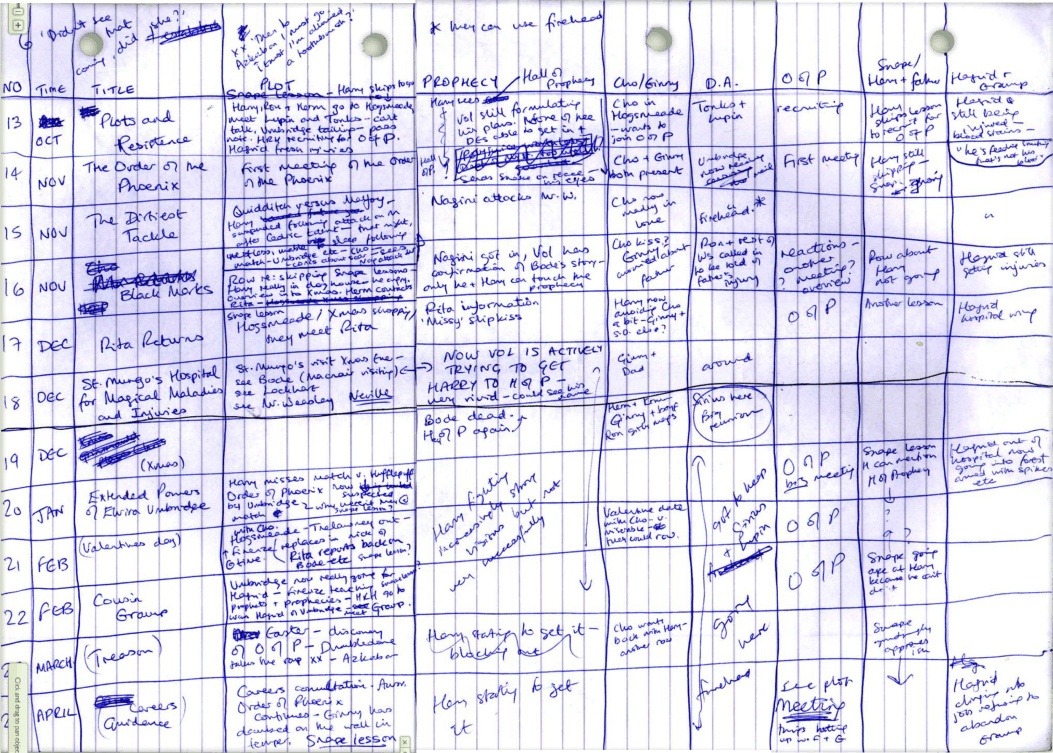
At the height of the Harry Potter novels' popularity, I asked a number of people why those books in particular enjoyed such a devoted readership. Everyone gave almost the same answer: that author J.K. Rowling "tells a good story." The response at once clarified everything and nothing; of course a "good story" can draw a large, enthusiastic (and, at that time, impatient) readership, but what does it take to actually tell a good story? People have probably made more money attempting, questionably, to pin down, define, and teach the best practices of storytelling, but at the top of this post, we have a revealing scrap of Rowling's own process. And I do, almost literally, mean a scrap: this piece of lined paper contains part of the handwritten plot spreadsheet she used to write the fifth Harry Potter novel, Harry Potter and the Order of the Phoenix.
This particular page (click to view it in a larger format) covers chapters 13 through 24, during which even more happens than you may now remember. It may have amounted to more than Rowling, too, could remember, hence the spreadsheet itself. Endpaper explains some of her story notes as follows:
- “Prophecy”: A subplot about the prophecy Harry finds himself concerned about all through the book
- “Cho/Ginny”: The book’s romantic subplot
- “D.A.”: What’s happening with the resistance army, or “Dumbledore’s Army”
- “O of P”: What’s happening with the “Order of the Phoenix” group
- “Snape/Harry”: What’s happening with Snape and Harry
- “Hagrid and Grawp”: What’s happening with Hagrid and Grawp
"If you think about Harry Potter and the Order of the Phoenix, that’s it," writes /Film's Germain Lussier. "Those columns pretty much encompass the whole story." Rowling, of course, hardly counts as the only novelist to write with such techniques, and based on this example, hers don't get nearly as elaborate as some. (I recall once reading that Vikram Chandra had to bust out Microsoft Project to keep track of the complications of Sacred Games, his 900-page novel about the Mumbai underworld.) But Rowling must certainly rank as the most famous novelist to, quite literally, draw up spreadsheets like this. I suppose it does leave her books even more exposed to accusations of overplotting than before, but something tells me it won't bother her.
Related Content:
Celebrate Harry Potter’s Birthday with Song. Daniel Radcliffe Sings Tom Lehrer’s Tune, The Elements.
Colin Marshall hosts and produces Notebook on Cities and Culture and writes essays on cities, language, Asia, and men’s style. He’s at work on a book about Los Angeles, A Los Angeles Primer. Follow him on Twitter at @colinmarshall or on Facebook.
Character Description in The Glass Menagerie
A Slap-Dash Production.
The Glass Menagerie by Tennessee Williams.
This is a follow-up to the earlier post on authors' description of their characters. Included here is Williams' technique and criticism of the theatre. A second part might include a brief discussion of where this play fits in with others, and another topic or two.
In a play there are generally two ways characters are described: what a character says of self, and what characters say of each other. This is purely method. A third way, possibly used at the first showing of Williams's play, is the program brochure that identifies characters and players. The printed version of Williams's play has the names of the characters and a description of them; and this information might have come from a brochure. For example, one character, Amanda, is described, here shortened, as "A little woman of great but confused vitality clinging frantically to another time and place". A fourth device in The Glass Menagerie is a character who relates what occurs onstage, including remarks on other characters. This is Tom; and the first name of Tennessee Williams, who wrote an imaginary version of his early life.
In the production notes, Williams writes: "Expressionism and all other unconventional techniques in drama have only one valid aim, and that is a closer approach to truth. When a play employs unconventional techniques, it is not, or certainly shouldn't be, trying to escape its responsibility of dealing with reality, or interpreting experience, but is actually or should be attempting to find a closer approach to more penetrating vivid expression of things as they are."
He goes on to say that the straight realistic play "has the same virtue of a photographic likeness", which he finds unimportant. He states that the "plastic theatre...must take the place of the exhausted theatre of realistic conventions if the theatre is to resume vitality as part of out culture". He employed illuminated images, music, lighting to enhance his work.
The essay, "The Catastrophe of Success", looking back to the period of The Glass Menagerie, is interesting reading: https://genius.com/Tennessee-williams-the-catastrophe-of-success-annotated
It concludes:
“In the time of your life—live!” That time is short and it doesn’t return again. It is slipping away while I write this and while you read it, and the monosyllable of the clock is Loss, loss, loss, unless you devote your heart to its opposition.
The Glass Menagerie by Tennessee Williams.
This is a follow-up to the earlier post on authors' description of their characters. Included here is Williams' technique and criticism of the theatre. A second part might include a brief discussion of where this play fits in with others, and another topic or two.
In a play there are generally two ways characters are described: what a character says of self, and what characters say of each other. This is purely method. A third way, possibly used at the first showing of Williams's play, is the program brochure that identifies characters and players. The printed version of Williams's play has the names of the characters and a description of them; and this information might have come from a brochure. For example, one character, Amanda, is described, here shortened, as "A little woman of great but confused vitality clinging frantically to another time and place". A fourth device in The Glass Menagerie is a character who relates what occurs onstage, including remarks on other characters. This is Tom; and the first name of Tennessee Williams, who wrote an imaginary version of his early life.
In the production notes, Williams writes: "Expressionism and all other unconventional techniques in drama have only one valid aim, and that is a closer approach to truth. When a play employs unconventional techniques, it is not, or certainly shouldn't be, trying to escape its responsibility of dealing with reality, or interpreting experience, but is actually or should be attempting to find a closer approach to more penetrating vivid expression of things as they are."
He goes on to say that the straight realistic play "has the same virtue of a photographic likeness", which he finds unimportant. He states that the "plastic theatre...must take the place of the exhausted theatre of realistic conventions if the theatre is to resume vitality as part of out culture". He employed illuminated images, music, lighting to enhance his work.
The essay, "The Catastrophe of Success", looking back to the period of The Glass Menagerie, is interesting reading: https://genius.com/Tennessee-williams-the-catastrophe-of-success-annotated
It concludes:
“In the time of your life—live!” That time is short and it doesn’t return again. It is slipping away while I write this and while you read it, and the monosyllable of the clock is Loss, loss, loss, unless you devote your heart to its opposition.
Subscribe to:
Posts (Atom)